
The Ultimate Step-by-Step Guide to Boost Rankings, Organic Traffic & Conversions
In today’s highly competitive digital ecosystem, ranking on Google is not just about adding keywords or publishing blogs. Search engines like Google evaluate hundreds of factors before deciding which website deserves the top position.
This is why professional agencies offering SEO services, digital marketing services, website optimization, and search engine optimization strategies rely heavily on a comprehensive SEO audit checklist.
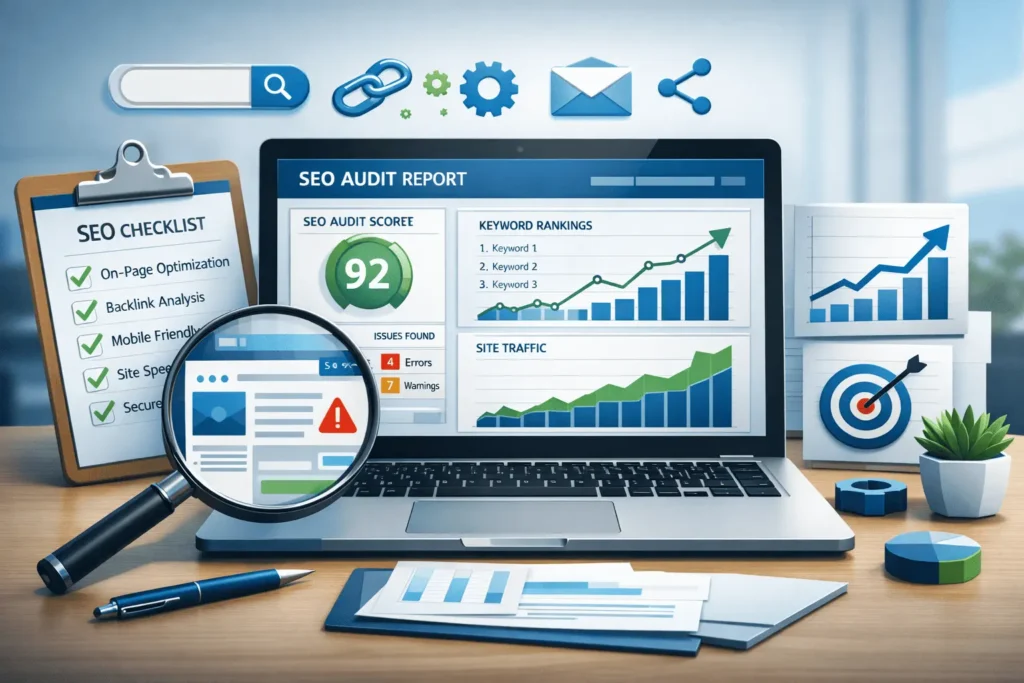
An SEO audit is not just a basic review—it is a deep technical, on-page, off-page, and performance analysis that helps identify gaps, fix errors, and unlock growth opportunities.
Whether you are running a business website, ecommerce store, Shopify website, WooCommerce store, or D2C brand, this complete SEO audit checklist will help you understand how top agencies deliver ROI-driven digital marketing results.
What is an SEO Audit?
An SEO audit is a detailed evaluation of your website’s:
- Technical health
- Content quality
- Keyword optimization
- Backlink profile
- User experience
- Search engine visibility
The goal is simple:
Identify issues that are stopping your website from ranking
Optimize everything for better performance
Professional SEO agencies use audits to create data-driven SEO strategies that improve:
- Organic traffic
- Keyword rankings
- Lead generation
- Conversion rate
Why SEO Audit is Critical for Business Growth
Without an SEO audit, you are basically guessing what’s wrong.
A proper audit helps:
✔ Fix technical errors affecting indexing
✔ Improve website speed and performance
✔ Optimize content with relevant keywords
✔ Increase search visibility
✔ Strengthen domain authority
✔ Improve user experience
✔ Boost conversion rate
Businesses investing in SEO services, ecommerce SEO, local SEO, and performance marketing rely on regular audits to stay ahead of competitors.
Complete Advanced SEO Audit Checklist
1. Technical SEO Audit
Technical SEO is the backbone of your website. If this is weak, nothing else will work effectively.
Website Speed & Core Web Vitals
- Page load time (should be under 3 seconds)
- Largest Contentful Paint (LCP)
- First Input Delay (FID)
- Cumulative Layout Shift (CLS)
Fast websites rank better and improve user experience.
Mobile-Friendliness
- Responsive design
- Mobile usability
- Touch-friendly navigation
Since most traffic is mobile, this is critical for SEO ranking and user experience.
Crawlability & Indexing
- XML sitemap properly submitted
- Robots.txt optimized
- No blocked important pages
- Pages indexed in Google
Use Google Search Console to check indexing issues.
URL Structure Optimization
- Clean, SEO-friendly URLs
- No unnecessary parameters
- Keyword inclusion in URLs
Fix Technical Errors
- 404 errors (broken pages)
- 500 server errors
- Redirect chains
- Duplicate pages
HTTPS Security
- SSL certificate installed
- Secure browsing (HTTPS)
Google prioritizes secure websites.
2. On-Page SEO Audit (Content Optimization Layer)
On-page SEO ensures your pages are optimized for target keywords and search intent.
Title Tags Optimization
- Include primary keywords
- Keep under 60 characters
- Make them clickable
Meta Description Optimization
- Include relevant keywords
- Add CTA
- Improve CTR (click-through rate)
Header Tags Structure
- Proper use of H1, H2, H3
- Keyword-rich headings
- Clear content hierarchy
Keyword Placement Strategy
- Primary keyword in title, H1
- Secondary keywords in subheadings
- Natural keyword usage
Avoid keyword stuffing.
Internal Linking Strategy
- Link related pages
- Improve crawlability
- Increase time on site
Image Optimization
- Use alt tags
- Compress images
- Use descriptive file names
3. Keyword Research & Optimization Audit
Keywords are the core of SEO success.
Keyword Targeting
- Primary keywords
- Long-tail keywords
- Transactional keywords
- Informational keywords
Search Intent Matching
- Informational (blogs)
- Navigational
- Transactional (buy intent)
Competitor Keyword Analysis
- Identify competitor ranking keywords
- Target gaps
- Improve content strategy
Using the right SEO keywords, local SEO keywords, ecommerce SEO keywords, and high-intent keywords ensures better rankings.
4. Content Audit (Ranking Engine)
Content is the most powerful ranking factor.
Content Quality Check
- Unique and original content
- Valuable and informative
- Keyword-rich but natural
Content Depth
- Long-form content performs better
- Cover complete topic
- Add FAQs and internal links
Duplicate Content Fix
- Avoid copied content
- Use canonical tags
Content Gap Analysis
- Identify missing topics
- Create new blogs
- Update old content
Professional agencies focus heavily on content marketing, blog SEO, and topic clusters.
5. Off-Page SEO Audit (Authority Building)
Backlinks build trust in Google’s eyes.
Backlink Profile Analysis
- Number of backlinks
- Quality vs quantity
- Domain authority
Remove Toxic Links
- Spam backlinks
- Low-quality directories
Anchor Text Optimization
- Natural anchor distribution
- Avoid over-optimization
Competitor Backlink Strategy
- Analyze competitor links
- Build similar or better backlinks
Strong backlinks improve domain authority and ranking power.
6. User Experience (UX) & Performance Audit
Google considers user behavior.
UX Factors:
- Easy navigation
- Clean design
- Mobile optimization
- Fast loading pages
Engagement Metrics:
- Bounce rate
- Time on site
- Pages per session
Better UX = better rankings + conversions.
7. Local SEO Audit (For City-Based Businesses)
For local businesses, this is critical.
Google My Business Optimization
- Complete profile
- Updated info
- Keywords added
NAP Consistency
- Name, Address, Phone same everywhere
Local Citations
- Business listings
- Directory submissions
Reviews & Ratings
- Positive reviews
- Regular responses
Local SEO helps rank in Google Maps & local search results.
8. Ecommerce SEO Audit
For ecommerce websites:
Product Page Optimization
- Keyword-rich titles
- Unique descriptions
- High-quality images
Category Page SEO
- Optimized categories
- Internal linking
Conversion Optimization
- Clear CTA
- Trust badges
- Easy checkout
Ecommerce SEO helps increase organic sales and traffic.
9. Conversion Rate Optimization (CRO)
Traffic without conversion = waste.
Optimize:
- Landing pages
- CTA buttons
- Forms
- Checkout process
CRO improves:
- Leads
- Sales
- ROI
10. Competitor SEO Analysis
Analyze competitors to win.
Check:
- Keywords they rank for
- Backlinks
- Content strategy
- Traffic sources
This helps build a stronger SEO strategy.
Tools Used by Professional SEO Agencies
- Google Search Console
- Google Analytics
- Ahrefs / SEMrush
- Screaming Frog
- PageSpeed Insights
These tools help in data-driven SEO audits and performance tracking.
Common SEO Audit Mistakes
❌ Ignoring technical SEO
❌ Keyword stuffing
❌ Poor content quality
❌ Low-quality backlinks
❌ No mobile optimization
❌ No tracking
SEO Audit Frequency
- Small websites → Every 3–6 months
- Ecommerce sites → Monthly
- Large websites → Continuous
Frequently Asked Questions
Q1. What is an SEO audit?
It is a complete analysis of your website’s SEO performance.
Q2. Why is SEO audit important?
It helps fix issues and improve rankings, traffic, and conversions.
Q3. How often should I do an SEO audit?
Every 3–6 months or regularly for best results.
Q4. Can SEO audit improve rankings?
Yes, it identifies issues and helps optimize your website.
Q5. Do I need an SEO agency for audit?
Professional agencies provide deeper insights and better optimization.